
Electra Secures Additional Patents Protecting its Advanced Hybrid-Electric Architecture for Ultra Short Takeoff and Landing Aircraft
SOURCE Electra.aero
Patents safeguard innovations that ensure normalized operations as the company advances certification of its hybrid-electric EL9 aircraft
MANASSAS, Va., Feb. 11, 2026 /PRNewswire/ -- Electra.aero, Inc. (Electra) has been granted a series of U.S. patents that protect core components of its groundbreaking hybrid-electric propulsion and flight control architecture, a system designed to enable Ultra Short takeoff and landing operations while maintaining conventional aircraft performance and safety margins. These patents cover critical elements necessary to deploy electric blown lift practically, advancing the company's protection of its nine-passenger Ultra Short aircraft.
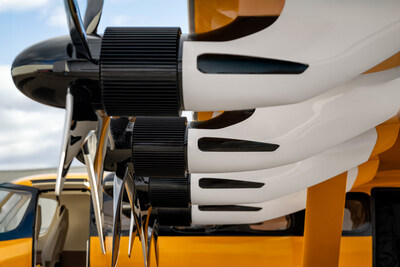
Together, the patents safeguard the control logic, power management, and pilot interface systems that define how Electra integrates electric propulsion into a practical, FAA-certifiable hybrid-electric platform. They cover systems and methods for controlling the flight path of a blown lift aircraft (US Pat. #12384550), pilot guidance display for that aircraft (U.S Pat. #12298151), and a battery disconnect system that improves maintenance, performance, and safety (U.S Pat. #12489181).
"Our patent portfolio protects our architecture and the ability to manage power, lift, and energy safety in a scalable hybrid-electric configuration," said Chris Courtin, Director of Technology Development at Electra. "Where traditional aircraft rely on aerodynamic control surfaces, our distributed propulsion system makes the motors themselves an active flight control element. That improves precision, reduces workload, and makes Ultra Short aircraft fly like any other fixed wing aircraft."
Integrating Power and Control
The flight path control patent describes a closed-loop system that enables pilots to command the aircraft's flight path angle through a single integrated power control interface. Instead of manipulating multiple throttles or configuration switches, the pilot simply selects a mode-takeoff, cruise, descent, or reverse-and the onboard computing system dynamically adjusts thrust across multiple electric propulsion units to maintain the desired flight path.
This architecture underpins Electra's blown-lift approach, in which distributed electric propulsors mounted along the wing accelerate airflow to dramatically increase lift at low speeds. The algorithms and lookup tables continuously optimize each propulsor's thrust by referencing real-time air data, aircraft attitude, and configuration sensors. The result is finely tuned, power-based control of lift and attitude, which is key to achieving reliable Ultra Short performance without compromising efficiency at cruise.
A Practical Path to Hybrid-Electric Flight
Electra's approach solves the range and infrastructure limitations that have hindered fully electric aircraft. Its hybrid-electric architecture uses a turbogenerator to supply continuous power to distributed electric propulsors, enabling long-range, payload-capable operations without relying on ground charging infrastructure.
Electra's system architecture enables Ultra Short takeoffs and landings in under 150 feet, utilizing existing runways, parking lots, and soccer-sized fields. The combination of distributed electric propulsion and a hybrid-electric powertrain delivers helicopter-like performance with the safety, range, and cost efficiency of a fixed-wing aircraft.
"These patents capture how we make electric propulsion not just feasible, but practical in the real world," said Courtin. "By simplifying control logic and embedding safety at the system level, we're enabling commercial hybrid-electric blown lift certification and deployment, on a proprietary basis."
Next Stop: Certification
Electra's EL2 technology demonstrator aircraft has already completed successful flight testing using Electra's proprietary hybrid-electric propulsion system. Electra continues to refine the integrated control software and power management logic as it advances toward commercialization of its flagship, nine-passenger EL9 Ultra Short aircraft.
With the EL9, Electra is pioneering Direct Aviation, a new model of regional air mobility that saves travelers time, maximizes existing infrastructure, and connects underserved communities. The first test flights are planned for 2027, with certification and commercial service entry anticipated in late 2029, into 2030 under FAA Part 23 regulations.
With over 2,200 pre-orders from more than 60 commercial customers worldwide, including both airlines and helicopter operators, the EL9 is already one of the most in-demand aircraft in the advanced air mobility (AAM) sector.
For more information, visit https://www.electra.aero.
About Electra.aero
Electra.aero, Inc. (Electra) is an advanced aerospace company building hybrid-electric Ultra Short airplanes that achieve unprecedented performance advantages to fly people and cargo seamlessly without airports, emissions, or noise. With the EL9 Ultra Short, Electra is pioneering Direct Aviation, the next level of connectivity that brings air travel closer to where we live, work, and play. Electra's Ultra Short technology delivers 2.5x the payload and 10x longer range with 70% lower operating costs than helicopters and eVTOLs with significantly greater safety and far less certification risk.
Electra's team includes some of the most respected and successful entrepreneurs and engineers in novel aircraft design, with over 40 prior aircraft successfully developed and/or certified. Lockheed Martin Ventures, Honeywell, and Safran are among Electra's strategic investors along with Prysm Capital, Statkraft Ventures (Norway's sovereign fund), the Virginia Innovation Partnership Corporation (VIPC), and other private investors. Electra's contracted customers include the U.S. Air Force, the U.S. Army, the U.S. Navy, and NASA along with over 2,200 letters of intent from 60+ commercial customers, including both airlines and helicopter operators.
Media Contact:
[email protected]

 View original content to download multimedia:
©PR Newswire. All Rights Reserved.
Information contained on this page is provided by an independent third-party content provider. XPRMedia and this Site make no warranties or representations in connection therewith. If you are affiliated with this page and would like it removed please contact [email protected]
