
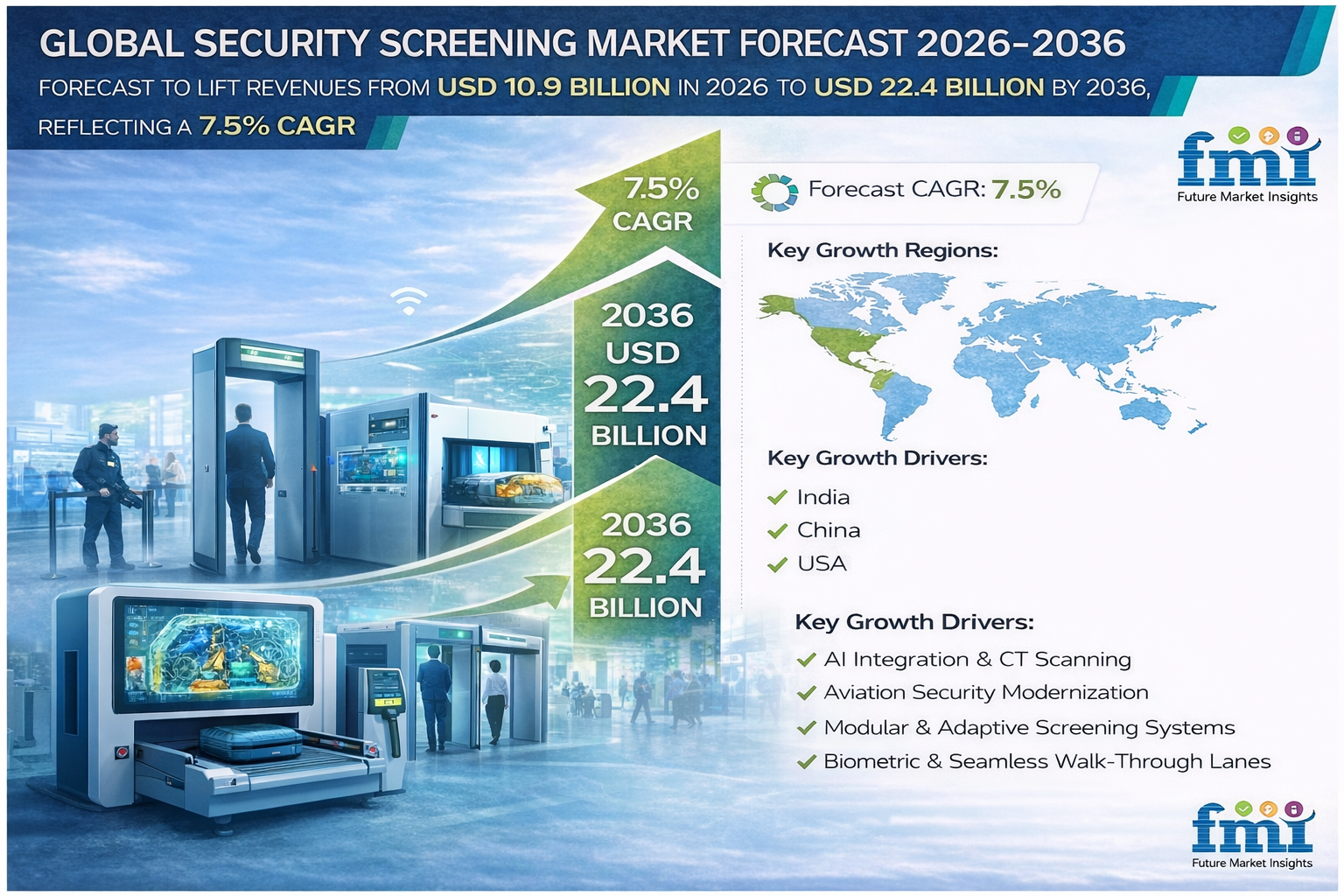
The Security Screening Market is Forecast to Lift Revenues From USD 10.9 Billion in 2026 to USD 22.4 Billion by 2036, Reflecting a CAGR of 7.5%
AI-Powered CT Screening, Biometric Integration, and Modular Software Platforms Accelerate Global Airport and Public Infrastructure Security Modernization
NEWARK, DELAWARE / ACCESS Newswire / February 18, 2026 / The global security screening ecosystem is entering a transformative growth phase, fueled by rapid technological innovation and rising global safety requirements. Valued at USD 10.9 billion in 2026, the security screening market is forecast to reach USD 22.4 billion by 2036, expanding at a CAGR of 7.5%. This growth reflects a fundamental shift toward intelligent, automated threat detection systems powered by artificial intelligence (AI), computed tomography (CT), and modular digital architectures. As governments, aviation authorities, and public infrastructure operators modernize their security frameworks, screening technologies are evolving from static hardware systems into software-defined, upgradeable digital platforms.
According to Future Market Insights (FMI), the next decade will be defined by seamless checkpoint experiences that combine enhanced threat detection accuracy with higher passenger throughput. Aviation authorities alone are expected to increase investments in walk-through screening corridors by nearly 30%, enabling efficient passenger flow while maintaining stringent security protocols.
The Technology Shift: From Hardware-Centric to Software-Defined Screening
Security screening is undergoing a material and architectural transformation. Traditional screening equipment, often dependent on fixed hardware upgrades, is being replaced by modular, software-upgradeable systems capable of adapting to evolving threat landscapes. This shift enables agencies to deploy detection algorithm updates without replacing expensive physical infrastructure.
Manufacturers are integrating AI-powered analytics with CT-based volumetric imaging, enabling automated threat identification with significantly reduced false alarm rates. These systems can process over 300 passengers per hour, representing a 50% throughput improvement compared to legacy x-ray technologies.
An industry analyst explains, "The competitive advantage is shifting toward vendors capable of delivering continuous software innovation. Recurring revenue from analytics, predictive maintenance, and software upgrades is becoming more important than one-time hardware sales."
This transition allows security operators to maintain compliance with evolving regulations while optimizing long-term capital expenditure.
Aviation Infrastructure Leads the Modernization Wave
Airports remain the largest adopters of advanced security screening systems, accounting for 41.3% of total market share in 2026. Increasing global air travel, combined with stricter international aviation security mandates, is driving sustained investment in checkpoint modernization.
Airports are rapidly deploying CT-enabled baggage scanners that allow passengers to keep electronics and liquids inside carry-on luggage. This enhances both operational efficiency and traveler convenience. Automated screening lanes, integrated tray return systems, and biometric verification platforms are further improving checkpoint performance while reducing staffing requirements.
Beyond aviation, governments are expanding screening infrastructure across metro systems, border checkpoints, stadiums, and critical infrastructure sites. The growing need to secure "soft targets" such as public venues and commercial buildings is accelerating adoption of discreet, high-throughput screening technologies.
Segment Spotlight: X-Ray Systems and Multimodal Detection Dominate
X-Ray Screening Systems:
X-ray-based screening technologies continue to lead the market, accounting for 26.1% of total system share in 2026. Their versatility in detecting concealed threats across baggage, cargo, and mail applications ensures sustained demand. The integration of CT capabilities has further strengthened their dominance by enabling detailed 3D visualization and automated threat classification.
AI-Integrated and Multimodal Detection:
Modern screening checkpoints increasingly combine multiple detection technologies, including trace explosive detectors, biometric authentication, and millimeter-wave scanners. These multi-layered architectures enhance detection accuracy while minimizing operational friction.
Digital Services and Predictive Maintenance Redefine Vendor Revenue Models
Security agencies are prioritizing long-term partnerships with vendors that offer comprehensive service support. Vendors with high customer satisfaction scores, measured through Net Promoter Scores (NPS) above 50, are 30% more likely to secure contract renewals. This highlights the growing importance of post-deployment services, maintenance, and analytics capabilities.
Predictive maintenance solutions are becoming a key differentiator, enabling operators to anticipate system failures before disruptions occur. This improves operational reliability while reducing downtime and maintenance costs.
Additionally, companies are optimizing customer acquisition strategies for government tenders. While acquiring a major airport contract may cost over USD 200,000 in bidding and testing, strategic partnerships with regional integrators can reduce acquisition costs by up to 15%, improving profitability over the contract lifecycle.
Regional Powerhouses: India, China, and the United States Drive Growth
Region / Country | CAGR | Key Growth Drivers |
India | 11.1% | Fastest-growing market globally, driven by regional airport expansion programs, metro infrastructure development, and stricter security regulations. Government initiatives supporting domestic manufacturing are accelerating deployment of advanced screening technologies. |
China | 8.5% | Growth supported by rapid construction of mega-airports and smart transportation hubs. Integration of biometric authentication with screening checkpoints enables seamless, automated passenger processing and improves operational efficiency. |
United States | 7.8% | Continued investment in checkpoint modernization, including replacement of legacy x-ray systems with advanced CT-based scanners. Strong defense and homeland security spending supports innovation and sustained market expansion. |
North America & Europe (Overall) | Mature Market | Primarily focused on system upgrades, modernization of existing infrastructure, and integration of AI-enabled and software-driven screening solutions rather than new large-scale deployments. |
Key Market Metrics and Growth Indicators (2026-2036)
Market Metric | Value
Industry Value (2026): USD 10.9 Billion
Projected Value (2036): USD 22.4 Billion
Global CAGR: 7.5%
Leading System: X-Ray Screening Systems (26.1% Share)
Leading Application: Airport Security (41.3% Share)
Key Growth Regions: India, China, United States
Operational Efficiency and Passenger Throughput Become Strategic Priorities
Security checkpoint performance is increasingly measured by throughput efficiency. Advanced CT screening lanes can process significantly higher passenger volumes without compromising detection accuracy.
Higher throughput reduces terminal congestion, improves passenger satisfaction, and allows airports to defer costly infrastructure expansions. This operational efficiency is becoming a critical factor influencing procurement decisions.
Biometric integration is also enabling "single-token travel," allowing passengers to move seamlessly through security checkpoints using unified identity verification.
Sustainability, Privacy, and Innovation Shape the Competitive Landscape
Environmental and privacy considerations are influencing technology development. Manufacturers are investing in millimeter-wave scanners and low-radiation technologies to address public health concerns while meeting regulatory requirements.
Simultaneously, AI-driven detection algorithms are improving screening accuracy while minimizing manual intervention. Companies are acquiring AI software startups and forming strategic partnerships to strengthen their digital capabilities.
Major industry players are also expanding into integrated command center solutions, enabling centralized monitoring and management of multiple screening points across transportation networks.
Competitive Landscape: Software Innovation and Strategic Partnerships Define Market Leadership
The competitive environment is intensifying as leading manufacturers transition toward software-centric platforms and service-based revenue models. Companies are investing heavily in AI, predictive analytics, and modular system architectures to enhance long-term value.
Top players shaping the global security screening market include:
Smiths Detection Group Ltd.
Leidos Holdings Inc.
OSI Systems, Inc.
3DX-RAY Ltd.
Teledyne Technologies Inc.
Analogic Corporation
Astrophysics Inc.
These companies are leveraging technological innovation, strategic acquisitions, and global service networks to strengthen their market positions.
Dynamics of the Decade: Intelligent Security and Seamless Mobility
Looking toward 2036, several transformational trends are expected to reshape the security screening ecosystem:
AI-Powered Threat Detection: Automated algorithms will improve detection accuracy and operational efficiency.
Modular and Upgradeable Platforms: Software-defined systems will enable continuous improvement without hardware replacement.
Biometric and Seamless Screening: Integrated identity verification will enable frictionless passenger movement.
Expansion Beyond Aviation: Growth will accelerate across public infrastructure, transportation hubs, and urban security applications.
As global mobility increases and threat landscapes evolve, the security screening market will play a critical role in ensuring safety while enabling efficient movement of people and goods. The convergence of AI, CT imaging, and software-driven innovation positions the industry for sustained expansion and technological leadership throughout the next decade.
For an in-depth analysis of evolving formulation trends and to access the complete strategic outlook for the Security Screening Market through 2036, visit the official report page at: https://www.futuremarketinsights.com/reports/security-screening-market
Related Reports:
Security Labels Market - https://www.futuremarketinsights.com/reports/security-labels-market
Security Tape Market - https://www.futuremarketinsights.com/reports/security-tape-market
Security Alarm Communicator Market - https://www.futuremarketinsights.com/reports/security-alarm-communicator-market
Security and Vulnerability Management Market - https://www.futuremarketinsights.com/reports/security-and-vulnerability-management-market
Security Holograms Market - https://www.futuremarketinsights.com/reports/security-holograms-marke
About Future Market Insights (FMI)
Future Market Insights (FMI) is a leading provider of market intelligence and consulting services, serving clients in over 150 countries. Headquartered in Delaware, USA, with a global delivery center in India and offices in the UK and UAE, FMI delivers actionable insights to businesses across industries including automotive, technology, consumer products, manufacturing, energy, and chemicals.
An ESOMAR-certified research organization, FMI provides custom and syndicated market reports and consulting services, supporting both Fortune 1,000 companies and SMEs. Its team of 300+ experienced analysts ensures credible, data-driven insights to help clients navigate global markets and identify growth opportunities.
For Press & Corporate Inquiries
Rahul Singh
AVP - Marketing and Growth Strategy
Future Market Insights, Inc.
+91 8600020075
For Sales - [email protected]
For Media - [email protected]
For web - https://www.futuremarketinsights.com/
SOURCE: Future Market Insights, Inc.
Information contained on this page is provided by an independent third-party content provider. XPRMedia and this Site make no warranties or representations in connection therewith. If you are affiliated with this page and would like it removed please contact [email protected]
