
Privacy Examiner Launches Independent Website Risk Detection & Monitoring Service for Healthcare Providers
Privacy Examiner, an independent website risk detection and monitoring company built specifically for healthcare providers, today announced the public launch of its compliance-focused website risk review and monitoring services for medical practices across the United States.
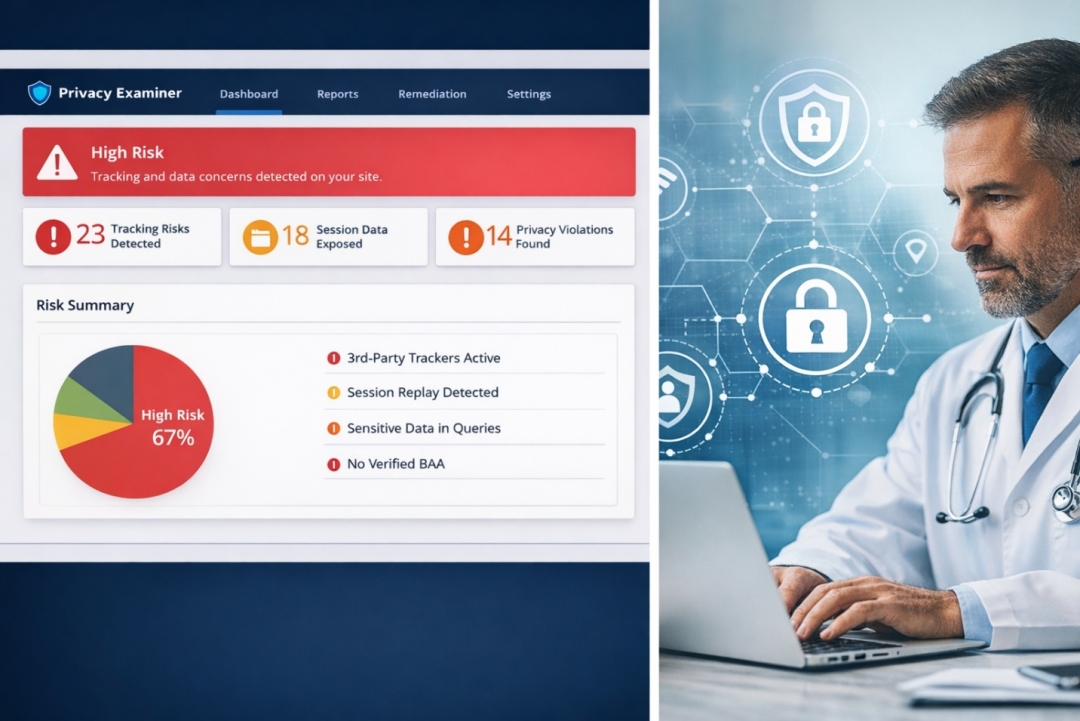
The company is designed to address a growing blind spot in healthcare compliance: third-party tracking technologies, marketing scripts, and embedded tools operating on public-facing medical websites that may create regulatory and patient-privacy exposure risk when tied to patient-related browsing or care-seeking activity.
“Most healthcare websites were built using standard marketing stacks that were never designed for regulated healthcare environments,” said Michael Knorr, President of Privacy Examiner. “Practices often believe their websites do not store sensitive patient information, yet common tracking technologies can link identifiers such as IP address or device ID with healthcare-related page visits. That combination can quietly create privacy and compliance exposure if it is not properly governed.”
Why Website Privacy Has Become a Current Healthcare Risk Issue
Between 2022 and 2024, the U.S. Department of Health and Human Services Office for Civil Rights clarified expectations around the use of online tracking technologies in healthcare contexts. In its bulletin on online tracking technologies, OCR emphasized that federal healthcare privacy rules may apply when identifiers are linked to healthcare-related interactions.
In parallel, joint communications from HHS and the Federal Trade Commission highlighted concerns about undisclosed third-party data sharing through website tracking technologies. These developments increased awareness that public-facing websites can fall within a healthcare organization’s broader compliance perimeter.
Privacy Examiner’s launch is timed to address this regulatory clarity and operational gap.
According to internal market analysis conducted during the company’s business planning phase, an estimated 750,000 to 900,000 U.S. healthcare providers operate public-facing websites, with approximately 65 to 75 percent showing at least one externally detectable website configuration that may create regulatory and patient-privacy exposure risk. That implies roughly 400,000 to 600,000 healthcare websites nationwide could be operating with material digital privacy and compliance risk tied specifically to tracking technologies, hosting posture, or third-party scripts.

What Privacy Examiner Detects
Privacy Examiner performs non-invasive, externally observable reviews of healthcare websites to identify technology categories that commonly create HIPAA exposure risk, including:
- Advertising and conversion tracking pixels
- Analytics platforms operating in healthcare contexts
- Session replay and behavioral recording tools
- Marketing automation tracking
- Third-party chat widgets
- Embedded scheduling tools
- Call tracking systems
- Hosted reverse proxies and performance CDNs
The company’s scanner coverage reflects an expanding signature library that includes marketing automation, visitor identification, call tracking, IP enrichment, and hosted CDN layers.
In addition, its public-facing explanations are written specifically for practice owners and administrators to translate technical findings into operational next steps.
Independent Examiner Model, Not a Marketing Agency
Privacy Examiner positions itself as a compliance authority rather than a marketing provider. According to its company overview, it does not certify HIPAA compliance, provide legal advice, or guarantee regulatory outcomes. Instead, it documents externally observable risk surfaces and supports remediation and monitoring.
The company’s internal standards intentionally apply a conservative operational risk posture. Privacy Examiner evaluates whether a configuration creates unavoidable third-party access to healthcare-related user activity and whether that access can be reliably constrained through architecture or contractual safeguards.
When appropriate, classifications reflect internal risk standards and do not represent a regulatory determination by HHS or OCR.
Site-Wide Protection Approach
Rather than recommending a page-by-page “clean page” isolation strategy, Privacy Examiner applies a site-wide protection model. The company notes that healthcare websites change continuously and that relying on marketers to classify individual pages as “safe” or “sensitive” creates operational fragility.
Under the site-wide model, all public pages are treated as risk-adverse surfaces by default. This approach reduces dependence on ongoing human discipline and provides clearer monitoring triggers when disallowed tools reappear.
How the Process Works
Privacy Examiner’s service model follows a staged approach:
1. Limited preliminary review of externally observable technologies.
2. Structured discovery discussion to review detected findings.
3. Comprehensive standards-based website risk assessment.
4. Remediation support to remove, replace, or restructure high-risk technologies.
5. Ongoing monitoring through a Digital Safety Compliance Officer program.
The company emphasizes documentation and clarity over alarmism. Its communications are guided by strict language controls that prohibit guarantees, legal conclusions, or enforcement claims.
Who Privacy Examiner Is Designed For
Privacy Examiner is designed for small and mid-size healthcare practices that:
- Rely on third-party marketing vendors
- Use analytics, pixels, or scheduling embeds on their websites
- Have not recently reviewed website tracking against current OCR guidance
- Want independent documentation of website-level risk surfaces
The company does not replace legal counsel, internal IT teams, or existing vendors. Instead, it provides independent visibility and monitoring designed to support those stakeholders.
Media and Practice Inquiries
Healthcare practices, compliance officers, and media representatives may request a confidential discussion through the company’s website:
Additional resources:
OCR Online Tracking Technologies Bulletin: https://www.hhs.gov/hipaa/for-professionals/privacy/guidance/hipaa-online-tracking/index.html
FTC and HHS Joint Statement on Tracking Technologies: https://www.ftc.gov/news-events/news/press-releases/2023/07/ftc-hhs-warn-hospital-systems-telehealth-providers-about-privacy-security-risks-online-tracking
About Privacy Examiner
Privacy Examiner is an independent website risk detection and monitoring company focused on identifying externally observable risk surfaces on healthcare websites. The company provides evidence-based detection, remediation support, and ongoing monitoring to help medical practices reduce HIPAA exposure risk tied to digital technologies.
Privacy Examiner is not a law firm and does not provide legal advice or certify HIPAA compliance. Classifications reflect internal risk standards and are not regulatory determinations by HHS or OCR.
Information contained on this page is provided by an independent third-party content provider. XPRMedia and this Site make no warranties or representations in connection therewith. If you are affiliated with this page and would like it removed please contact [email protected]
